Dernière mise à jour le 2 février 2026
Une base de preuves pour la formation, la pratique et la supervision
Ce corpus rassemble une sélection de publications scientifiques de référence utilisées pour former, pratiquer et superviser la symptothermie, la symptothermie scientifique et leurs prolongements intégratifs en gynécopédie.
Il ne vise pas l’exhaustivité. Il s’agit d’un socle de références pivot, choisies pour leur valeur méthodologique, leur lisibilité pédagogique et leur utilité professionnelle.
👉 La bibliothèque scientifique complète, incluant d’autres publications, des notes de lecture et des dossiers thématiques, est réservée aux conseillères certifiées restant sous supervision.
Accès rapide
- C1 — Synthèses & cadrage (P0)
- C2 — Efficacité « symptothermal / symptothermie » (P0)
- C3 — Fenêtre fertile & biologie de la conception (P0)
- C4 — Biomarqueurs : glaire, jour sommet, LH, échographie (P0)
- C5 — Température basale, progestérone & phase lutéale (P0–P1)
- C6 — Post-partum & allaitement (LAM) (P0)
- C7 — Ménarche & cycle comme signe de santé (P0)
- C8 — Périménopause & transitions (P0)
- C9 — SOPK & cycles complexes (P1)
- C10 — Applications prédictives vs observation (P0–P1)
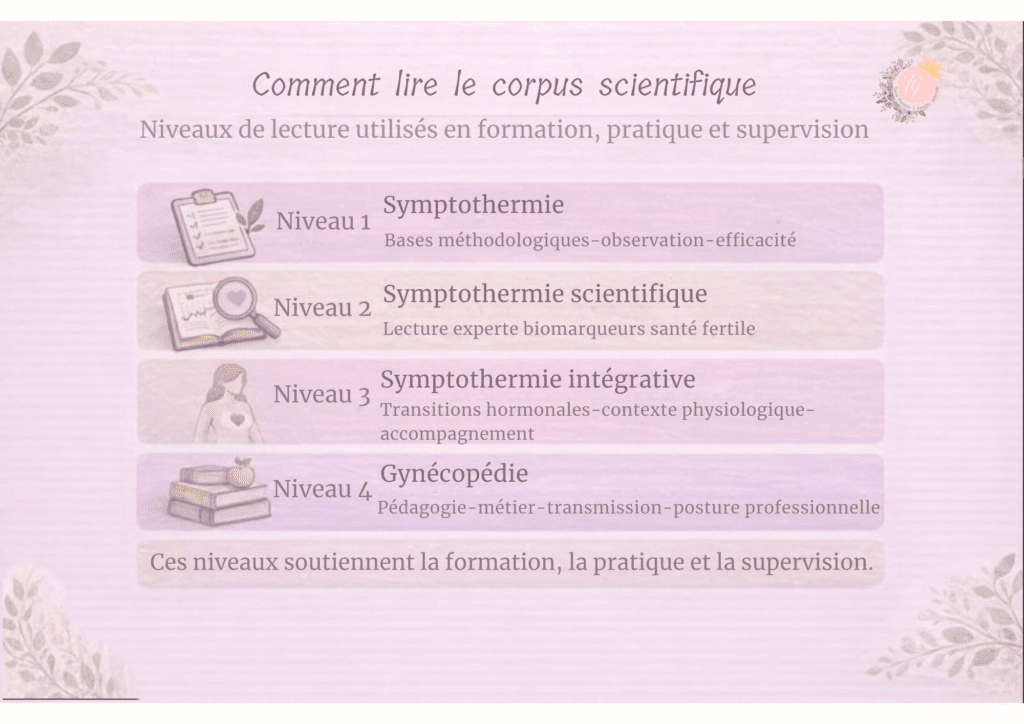
Comment lire ce corpus
- N1 : Symptothermie
- N2 : Symptothermie scientifique
- N3 : Symptothermie intégrative / santé féminine
- N4 : Gynécopédie / pédagogie / métier
C1 — Synthèses & cadrage (P0)
Effectiveness of Fertility Awareness–Based Methods for Pregnancy Prevention: A Systematic Review
Urrutia et al., 2018 — SR — PMID: 30095777 — N1
→ Revue systématique de référence sur l’efficacité contraceptive des FABM.
Fertility Awareness-Based Methods for Women’s Health and Family Planning
Duane et al., 2022 — Review — PMID: 35685421 — N1–N2
→ Cadrage global des FABM : contraception, conception et santé des femmes.
A review of effectiveness for avoiding pregnancy using fertility awareness–based methods
Manhart et al., 2013 — Review — (Contraception) — N1
→ Analyse comparative des méthodes d’observation dans la prévention des grossesses.
The future of professional education in natural family planning
Fehring, 2004 — Perspective / Review — PMID: 14971551 — N4
→ Réflexion fondatrice sur la formation professionnelle et la transmission.
C2 — Efficacité « symptothermal / symptothermie » (P0)
The effectiveness of a fertility awareness based method to avoid pregnancy in relation to a couple’s sexual behaviour (European NFP Study)
Frank-Herrmann et al., 2007 — Étude prospective — PMID: 17314078 — N1
→ Étude prospective majeure reliant efficacité et comportement du couple.
Effectiveness of the sympto-thermal method of natural family planning
Rice & Lanctôt — Study — (année selon édition) — N1
→ Données complémentaires sur l’efficacité de la méthode symptothermique.
C3 — Fenêtre fertile & biologie de la conception (P0)
Timing of sexual intercourse in relation to ovulation
Wilcox et al., 1995 — Study — PMID: 7477165 — N2
→ Définition probabiliste de la fenêtre fertile humaine.
Pregnancy and the Timing of Intercourse
NEJM, 1996 — Study — DOI: 10.1056/NEJM199605093341911 — N2
→ Article de référence sur le lien timing ↔ conception.
C4 — Biomarqueurs : glaire, jour sommet, LH, échographie (P0)
Chronological aspects of ultrasonic, hormonal, and other indices of ovulation
Ecochard et al., 2001 — Study — PMID: 11510707 — N2
→ Corrélation échographie, hormones et biomarqueurs observables.
Self-identification of the clinical fertile window and the ovulation day using cervical mucus
Ecochard et al., 2015 — Study — (Fertility & Sterility) — N2
Accuracy of the Peak Day of Cervical Mucus as a Biological Marker of Fertility
Fehring et al., 2002 — Study (accuracy + inter-rater) — N2
Cervical mucus and identification of the fertile phase of the menstrual cycle
Flynn et al., 1976 — Study — PMID: 952797 — N2
Using cervical mucus and other easily observed biomarkers to detect ovulation
Zinaman et al., 2006 — Review — PMID: 17061970 — N2
A comparison of the fertile phase determined by a fertility monitor vs cervical mucus
Fehring et al., 2004 — Study — PMID: 14720613 — N2
Interobserver variation in interpreting cervical mucus as an indicator of the fertile phase
Bassi et al., 2003 — Methods / reliability — N2
C5 — Température basale, progestérone & phase lutéale (P0–P1)
Descriptive analysis of the relationship between progesterone and basal body temperature across the menstrual cycle
Écochard et al., 2022 — Study — PMID: 35065994 — N2
→ Clarification physiologique du lien progestérone ↔ température.
C6 — Post-partum & allaitement (LAM) (P0)
Lactational amenorrhoea method for family planning
Van der Wijden et al., 2015 — Revue Cochrane — PMID: 26457821 — N3
Clinical study of the lactational amenorrhoea method for family planning
Pérez et al., 1992 — Study — PMID: 1348806 — N3
Multicenter study of the Lactational Amenorrhea Method (LAM): I. Efficacy, duration, implications
Labbok et al., 1997 — Multicenter — PMID: 9262927 — N3
Multicenter study of LAM under “post-marketing” conditions
Peterson et al., 2000 — Multicenter — PMID: 11172792 — N3
C7 — Ménarche & cycle comme signe de santé (P0)
Menstruation in Girls and Adolescents: Using the Menstrual Cycle as a Vital Sign
ACOG Committee Opinion, 2015 — Guideline — PMID: 26595586 — N3
The menstrual cycle: a biological marker of general health in adolescents
Popat et al., 2008 — Review — PMID: 18574207 — N3
Menstruation in Adolescents: What Do We Know?
Hillard, 2014 — Review — N3
C8 — Périménopause & transitions (P0)
Executive summary of STRAW +10
Harlow et al., 2012 — Consensus / Guideline — N3
The ReSTAGE Collaboration: defining bleeding criteria for onset of early menopausal transition
Harlow et al., 2008 — Study — DOI: 10.1016/j.fertnstert.2007.02.015 — N3
Menstrual Cycle Changes as Women Approach the Final Menstrual Period
Harlow et al., 2018 — Review — N3
C9 — SOPK & cycles complexes (P1)
Usefulness of the Sympto-Thermal Method with Standardized Cervical Mucus Assessment (InVivo) in Women with PCOS
Stachowska et al., 2024 — Study — PMID: 38891183 — N2–N3
C10 — Applications prédictives vs observation (P0–P1)
The Accuracy of Web Sites and Cellular Phone Applications in Predicting the Fertile Window
Setton et al., 2016 — Study — PMID: 27275788 — N1–N2
Do fertility tracking applications offer women useful information?
Ali et al., 2021 — Audit study — N1–N2
A Critical Appraisal of Fertility and Menstrual Tracking Apps
JOGC, 2019 — Review / appraisal — N1–N2
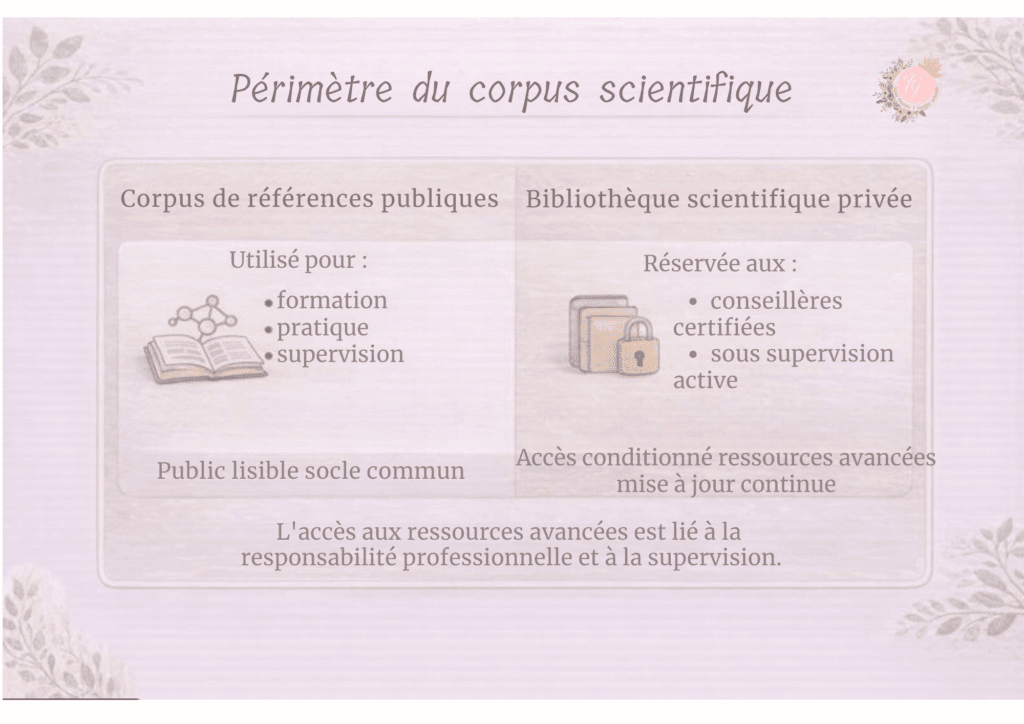
Accès à la bibliothèque privée
La bibliothèque scientifique complète (références étendues, notes de lecture, dossiers thématiques, outils de supervision) est accessible après certification, et maintenue tant que la conseillère reste affiliée et sous supervision.